

Introduction
When people need a doctor, dentist, specialist, or medical clinic, one of the first places they turn to is Google. Patients may search for terms such as “doctor near me,” “best dermatologist in Ahmedabad,” “dentist in Ahmedabad,” or a specific treatment they need. If your clinic does not appear prominently in these searches, potential patients may choose another healthcare provider that is easier to find online. This is where SEO for doctors becomes an important part of modern patient acquisition.
Medical SEO is not simply about ranking a website for more keywords. It is about helping the right patients discover accurate information, understand your expertise, find your clinic, and take the next step toward an appointment. A successful strategy combines local SEO, Google Business Profile optimization, healthcare website SEO, useful medical content, technical performance, and strong trust signals.
For doctors and clinics, search visibility can influence more than website traffic. A well-optimized online presence can help increase relevant enquiries, phone calls, direction requests, appointment bookings, and awareness within the local community.
Whether you run a single-doctor practice, dental clinic, specialty center, hospital department, or multi-location healthcare organization, medical practice SEO can provide a sustainable way to build online visibility. This guide explains practical SEO strategies for doctors and clinics, including local search optimization, Google Business Profile management, medical website best practices, and common mistakes to avoid.
Why SEO Matters for Doctors and Clinics
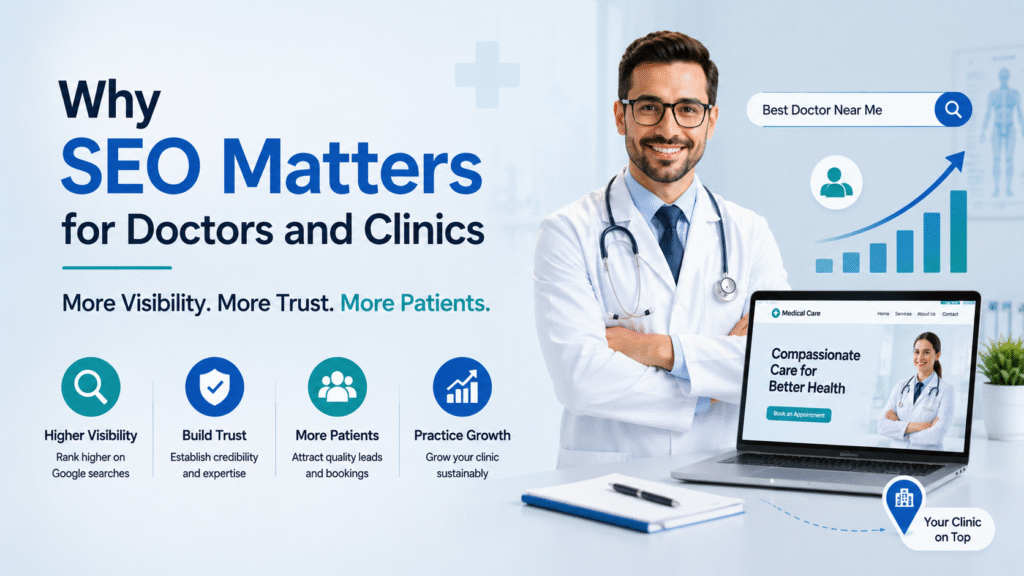
SEO for doctors helps medical professionals become visible when potential patients search Google for a doctor, specialist, treatment, or clinic in their area. Unlike traditional advertising, SEO can connect your practice with people who are already looking for healthcare information or trying to book an appointment. A strong strategy combines useful medical content, local search optimization, a trustworthy website, and an accurate Google Business Profile.
Healthcare is also different from many other industries because medical websites fall into a high-trust category. Patients want to know who is treating them, what services are available, where the clinic is located, and whether the information they read is credible. This makes expertise, accurate information, transparent doctor profiles, and clear sources particularly important. Research into health-related search results also suggests that perceived expertise and trust strongly influence how people evaluate medical content. (arXiv)
For example, a dermatologist in Ahmedabad could target searches such as “dermatologist in Ahmedabad,” “skin specialist near me,” or “acne treatment in Ahmedabad.” A dentist could build dedicated pages around “dentist near me,” “root canal treatment,” or “dental implants in Ahmedabad.” The objective is not simply to increase website traffic. It is to attract relevant visitors who can become calls, appointment enquiries, direction requests, or consultations.
Effective medical practice SEO therefore connects three things: visibility, credibility, and conversion. Your website may rank well, but if patients cannot easily find your phone number, location, appointment process, qualifications, or services, rankings alone will not create meaningful growth.
A useful internal linking opportunity here is to connect this section with pages such as “local SEO services,” “Google Business Profile optimization,” and “SEO for healthcare websites.”
Local SEO Strategies to Attract Nearby Patients
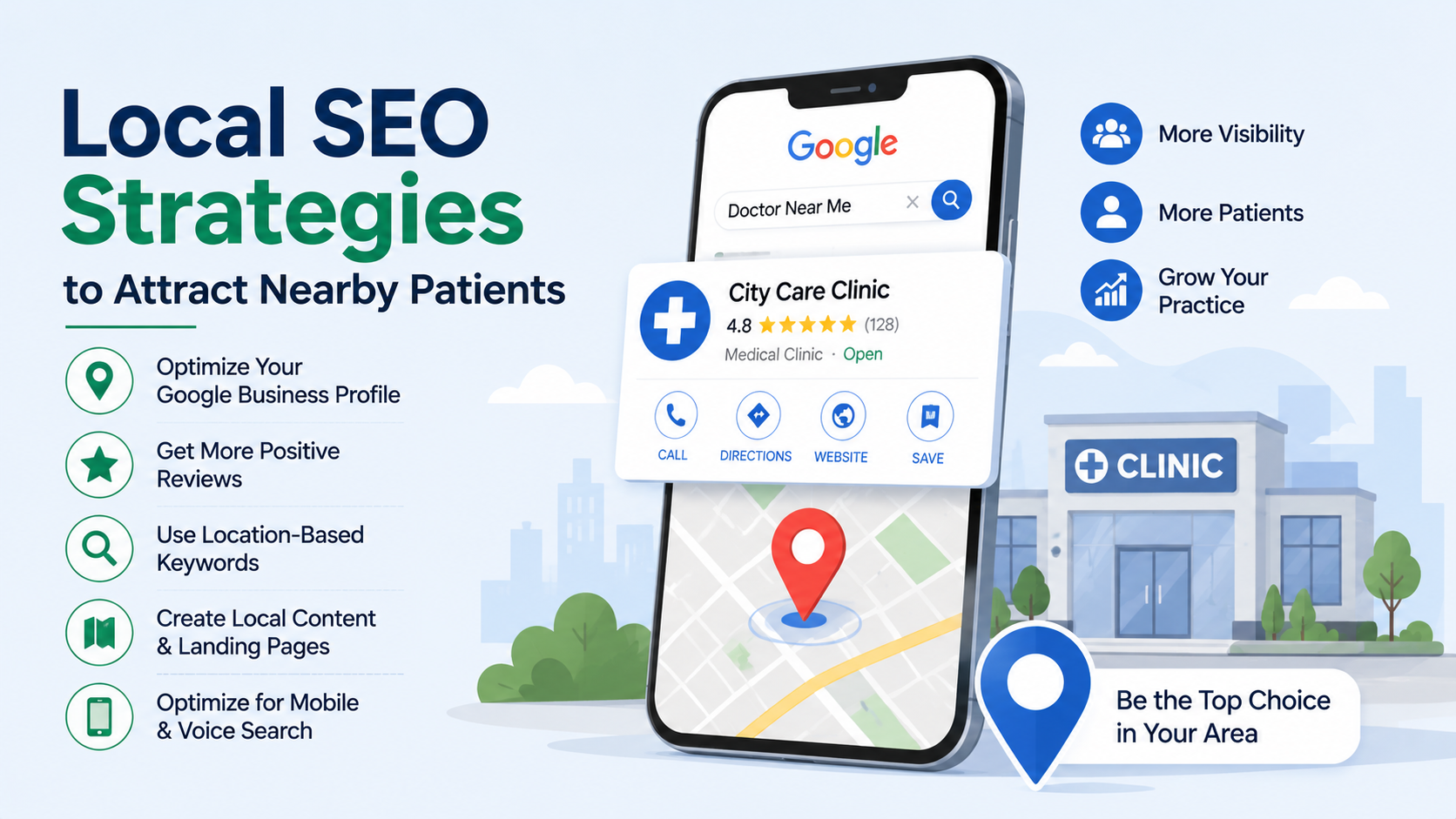
Local SEO for doctors focuses on making your practice visible to people searching for healthcare services in a specific location. Local SEO helps doctors appear in Google Search and Maps when nearby patients search for services such as “cardiologist near me,” “dentist in Ahmedabad,” or “pediatrician near me.” The strategy combines Google Business Profile optimization, location-focused website content, consistent business information, reviews, and strong local relevance. (tytstudio.com)
Start by identifying the searches your actual patients use. Instead of targeting only broad terms such as “doctor,” build keyword groups around specialty + service + location + patient intent. For example, an orthopedic clinic could target “orthopedic doctor in Ahmedabad,” “knee pain specialist in Ahmedabad,” and relevant treatment searches. A dental practice may target “dentist in [area],” “root canal dentist,” and “dental clinic near me.”
Your website should support these searches with dedicated, genuinely useful service and location pages. Avoid creating dozens of almost identical city pages simply by replacing one location name. Each location page should provide meaningful local information, including the clinic address, doctor availability, services, parking or access information where appropriate, and a clear appointment pathway.
Consistency also matters. Your clinic name, address, phone number, website, and opening hours should remain accurate across your website and relevant business directories.
Reviews are another important trust signal for local healthcare searches. Encourage genuine patients to share honest experiences without offering incentives or attempting to manipulate ratings. Google Business Profile, local citations, doctor directories, and relevant healthcare platforms can all support local discovery when managed accurately. (paperboattechsol.com)
The practical goal is simple: when someone nearby searches for a healthcare service you provide, your clinic should be easy to discover, easy to evaluate, and easy to contact.
Optimizing Google Business Profile for Healthcare
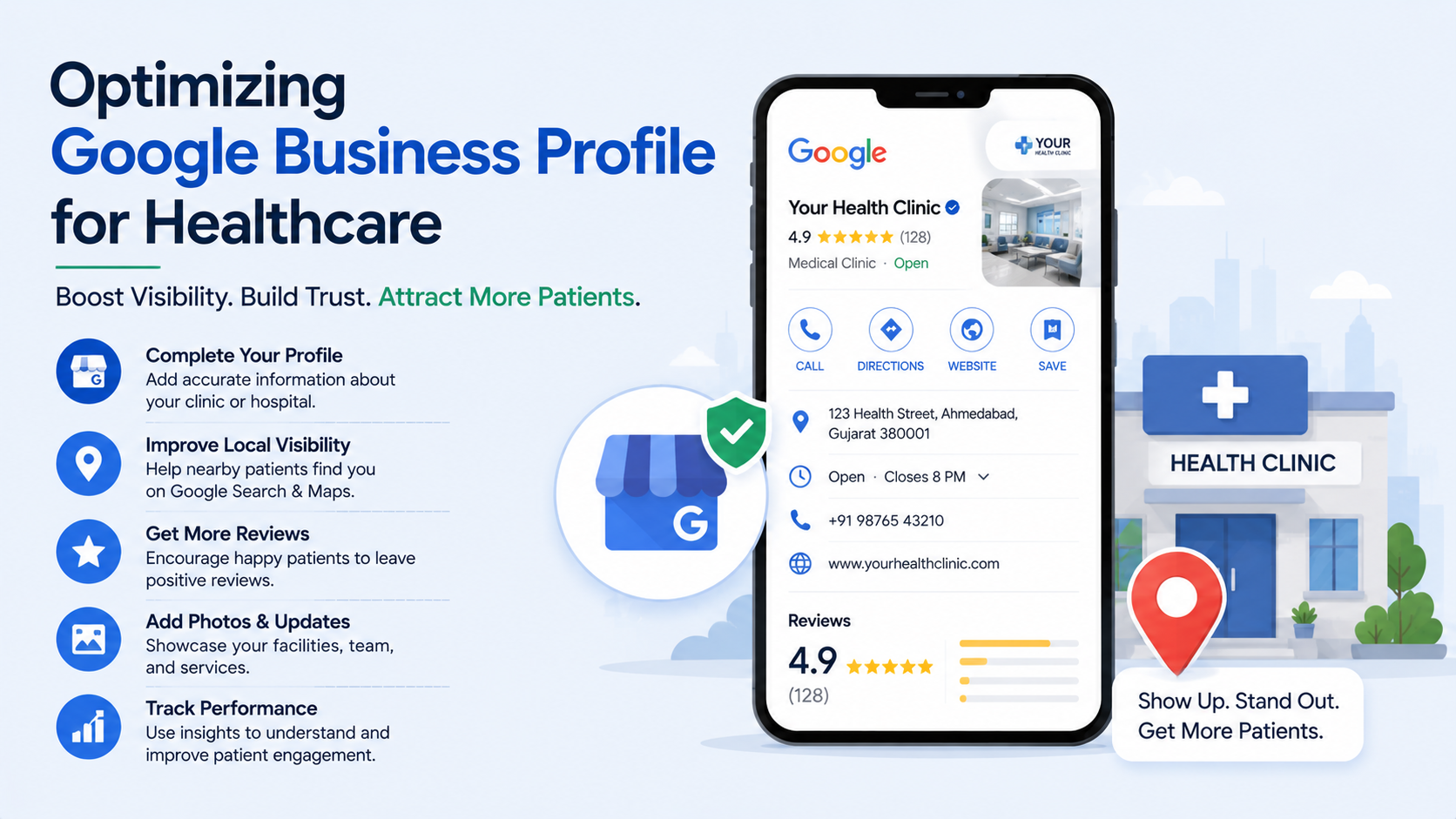
A Google Business Profile for doctors is one of the most important assets for local patient discovery because it can display your clinic information directly in Google Search and Maps. To optimize it, keep your official business name, primary category, address, phone number, hours, services, website, photos, and appointment information accurate and consistent. Then maintain the profile instead of treating it as a one-time setup. (DoubleSure)
Begin with the correct primary category. A dental clinic, dermatology clinic, physiotherapy practice, or specialist medical practice should use the category that most accurately represents the real business. Avoid adding keywords to the business name simply to influence rankings.
Complete every relevant section of the profile. Add accurate services, appointment information, clinic photographs, entrance images, waiting-area photographs, and professional images of the doctor where appropriate. Keep opening hours updated, especially during holidays or temporary schedule changes. An incorrect phone number or outdated timing can turn a potential patient into a lost enquiry.
Reviews should be handled carefully. Genuine patient feedback can help prospective patients understand the experience of visiting your practice, but healthcare businesses should never manufacture reviews or pressure patients into providing misleading feedback. Respond professionally and protect patient confidentiality when replying publicly.
Google Business Profile optimization should also work together with your website. Your profile can send users to relevant service pages rather than simply the homepage. For example, a dental clinic can connect its profile to a useful dental services page, while a specialist can direct visitors toward a clear consultation or specialty page.
Track meaningful actions rather than focusing only on profile views. Monitor calls, website visits, direction requests, appointment interactions, and changes in local visibility. Current healthcare SEO providers similarly emphasize Maps visibility, profile completeness, reviews, and appointment-related actions as core components of local search strategy. (DoubleSure)
For stronger internal navigation, link this section to “Google Business Profile optimization,” “local SEO for doctors,” and your clinic’s individual service pages.
Medical Website SEO Best Practices
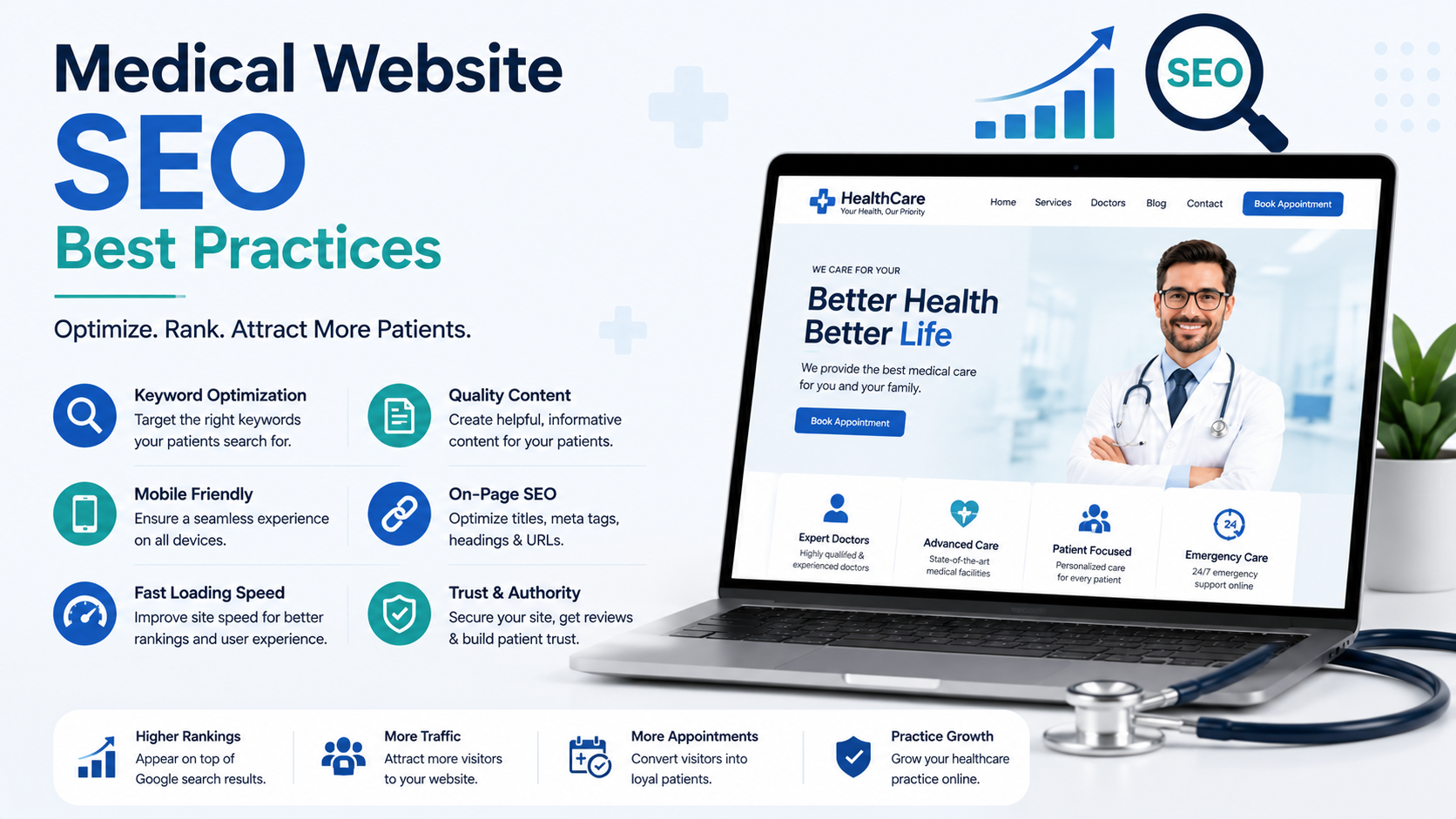
SEO for healthcare websites should make medical information easy to discover, understand, verify, and act on. A strong medical website needs technically sound pages, clear service information, trustworthy doctor profiles, location signals, useful patient-focused content, fast mobile performance, descriptive page titles, logical internal links, and clear appointment calls to action. In healthcare, SEO should support trust rather than simply adding keywords to pages.
A practical doctor website SEO checklist starts with the basics. Each important page should have a unique title, descriptive meta description, logical heading structure, clean URL, optimized images, useful internal links, and a clear purpose. Treatment and service pages should explain what the service is, who may need it, what patients can generally expect, and how they can contact the practice. Medical claims should be accurate and reviewed appropriately.
Doctor profile pages are particularly valuable for EEAT. Include qualifications, specialization, professional experience, areas of practice, affiliations where appropriate, and a clear professional photograph. Make it obvious who is responsible for medical information published on the website. Where medical content is written or reviewed by qualified professionals, clearly communicate that editorial process.
Technical performance also matters. The site should work well on smartphones because many healthcare searches happen when users are away from a desktop. Important appointment information should not be hidden behind complicated navigation. The phone number, location, consultation options, and booking pathway should be easy to find.
Structured data can also help search engines understand entities such as doctors, organizations, services, locations, and other relevant information when implemented correctly. A healthcare website should not rely on schema alone, however; structured data cannot compensate for weak or inaccurate content.
A useful content strategy answers real patient questions. For example, a dentist could publish educational resources around root canals, dental implants, oral hygiene, or treatment preparation. A physiotherapist might cover common rehabilitation questions. These resources can attract informational searches while internal links guide relevant visitors toward service pages.
The strongest medical SEO strategy combines technical quality + medical credibility + search intent + local relevance + conversion usability rather than treating rankings as the only objective. Current healthcare SEO guidance similarly emphasizes treatment pages, technical optimization, local visibility, trust signals, and clear conversion paths. (Health Digital)
Common SEO Mistakes Healthcare Professionals Make

One of the biggest SEO mistakes doctors and clinics make is treating healthcare SEO like ordinary business SEO. Medical websites require greater attention to accuracy, trust, author expertise, patient experience, and responsible content practices. A clinic may have an attractive website and still struggle to generate organic enquiries because important search intent is not being addressed.
Common mistake | Why it hurts | Better approach |
Targeting only “doctor” | Too broad and competitive | Target specialty, service, and location intent |
Ignoring Google Business Profile | Reduces local discovery | Maintain an accurate, complete profile |
Creating thin service pages | Provides little patient value | Build detailed, useful service pages |
Keyword stuffing | Makes content unnatural | Use keywords naturally around search intent |
No doctor expertise information | Weakens trust | Add detailed professional profiles |
Duplicate location pages | Creates low-value content | Build genuinely useful local pages |
Ignoring mobile performance | Poor patient experience | Optimize speed, usability, and navigation |
Buying or fabricating reviews | Creates trust and compliance risks | Encourage genuine patient feedback |
Publishing unreviewed medical claims | Can damage credibility | Use accurate, appropriately reviewed information |
Another common problem is focusing exclusively on rankings. A clinic may rank for a keyword but still receive few appointments if the page does not answer the patient’s question or provide a clear next step. SEO for dentists, for example, should not stop at ranking for “dentist.” The website should help visitors understand services, doctor credentials, location, consultation options, and how to book.
Healthcare professionals should also avoid publishing large volumes of generic AI-generated medical articles without proper review. AI can support research, outlining, and content workflows, but medical information should be checked for accuracy and presented responsibly. Search visibility should never come at the expense of patient safety or trust.
Finally, do not expect instant results. Local rankings can vary by location, competition, search intent, and the existing authority of a website. A sustainable medical practice SEO strategy usually requires consistent technical improvements, useful content, local optimization, reputation development, and performance monitoring over time. Multi-location clinics also require separate local strategies rather than simply copying one page across every branch. (Doctor Rank)
The best way to approach SEO is to ask one question before every optimization: Will this make it easier for the right patient to find, understand, trust, and contact this practice? If the answer is yes, the SEO work is more likely to create value beyond rankings.
Conclusion
SEO for doctors has become an important part of building a visible and trustworthy healthcare practice online. Patients increasingly use search engines to research symptoms, treatments, specialists, clinics, locations, and appointment options. For doctors and clinics, being present at the right moment can make the difference between a potential patient discovering your practice or choosing another provider.
A successful strategy goes beyond adding keywords to a website. It combines local SEO for doctors, Google Business Profile optimization, healthcare website SEO, useful medical content, technical optimization, genuine reputation signals, and a clear patient journey. Every part of the online presence should work together to answer the questions patients are asking and make it easy for them to take the next step.
Doctors should also remember that healthcare SEO is ultimately about trust. Accurate information, transparent qualifications, professional expertise, genuine reviews, and a reliable website are more valuable than shortcuts designed only to manipulate rankings. Search visibility should support a better patient experience, not replace it.
Whether your goal is to attract more local patients, increase appointment enquiries, improve Google Maps visibility, or build long-term organic traffic, a structured medical practice SEO strategy can create a stronger digital foundation for your clinic.
The most effective approach is to start with the fundamentals: understand your patients’ search behavior, optimize your Google Business Profile, strengthen important website pages, create genuinely useful content, fix technical issues, and continuously measure meaningful outcomes such as calls, enquiries, bookings, and qualified website visits.
When SEO is approached as a long-term investment in visibility, credibility, and patient accessibility, doctors and clinics can build an online presence that continues to generate value well beyond a single advertising campaign.
FAQ
SEO for doctors is the process of optimizing a doctor’s website, Google Business Profile, online content, and local presence so potential patients can find the practice through search engines. It includes local SEO, technical website optimization, service-page optimization, content creation, reputation management, and improving the overall patient experience online.
SEO helps doctors reach patients who are actively searching for healthcare services. Instead of relying only on referrals, advertisements, or social media, a strong SEO strategy can help your clinic appear when people search for relevant doctors, treatments, specialties, and nearby healthcare providers. It can support long-term visibility and generate qualified enquiries.
propriety.
Doctors can get more patients online by combining local SEO, an optimized Google Business Profile, a trustworthy medical website, useful service pages, patient-focused content, genuine reviews, and clear appointment options. The strategy should focus on attracting people with relevant search intent rather than simply generating large amounts of website traffic.
Local SEO for doctors focuses on improving a medical practice’s visibility in location-based searches such as “cardiologist near me,” “dentist in Ahmedabad,” or “skin specialist near me.” It includes Google Business Profile optimization, accurate business information, location-focused website content, local citations, reviews, and other signals that help search engines understand where a practice operates.